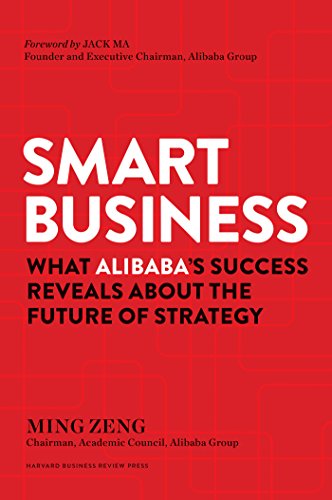
What Alibaba’s Success Reveals about the Future of Strategy
Author: Ming Zeng
Purchase on: Amazon
📖 The book in 3 sentences
An unfamiliar observer may find it easy to imagine China as it was two decades ago (the world’s factory, undeveloped and filled with copycat businesses), when the truth is that China is now in many ways ahead of Western counterparts (e.g. China is virtually cashless and check-less).
To understand this rapid progress the author proposes a new strategic framework called smart business: the mutual reinforcement of network coordination and data intelligence enabled by technology like machine learning.
Smart businesses apply self-tuning thinking to strategy, shifting focus from static planning to dynamic experimentation and learning.
👉 Why it matters
As a senior executive of Alibaba and a professor of strategy, Ming Zeng is the perfect person to share valuable insights about the company while breaking down the most important ideas and practices in a simple and practical way.
This book is not about Alibaba, it uses Alibaba as the main example to talk about a new strategic framework (smart business) based on data intelligence and network coordination.
A guiding principle in this book is that China was able to jump ahead of many other countries, building internet-native ecosystems where Western counterparts have been restricted by legacy infrastructure and high switching costs. So, from a Western point of view, China is like a glimpse into the future and can give business leaders a fresh perspective.
Not only this, but teaching strategy around the world, the author quickly discovered that what was happening with Alibaba could not be explained by the business and strategy theories he had learned and was teaching. So, this book is also an example on how to navigate a new and unknown strategic landscape.
💭 Thoughts
During my time in China in early 2015, I was already then amazed at how it felt like a parallel dimension. It felt like the platforms I was used to online had their own counterparts, the same but different. I was wrong, I quickly discovered that many of the platforms I started using in China were more advanced compared to the ones I was used to at home.
For example, the way in which I could buy things and interact with businesses through WeChat were simply impossible with WhatsApp. I was also talking to a friend last year who periodically travels to Tianjin with groups of students. He said “every time I come back from China and land in the US for a connecting flight, I suddenly feel like I am in a third world country”.
The comparison might be a bit extreme, but highlights an important fact that I identified with in this book. Even today when everything feels so connected, and most would agree that we should keep an open mind, it is still easy to get stuck in our own bubble. There is so much we don’t know, so we need to stay humble and realize that there is much to learn from other countries and cultures.
I agree with the author that as the world changes at an accelerated speed, it becomes more difficult to predict the future, and that’s precisely when it is most important to do so. I really appreciate how this book breaks down success in some of the larger tech companies today and builds a new strategic framework that unites core competencies seen in both the East and the West.
💡 My top 3 quotes
“Alibaba is not China’s version of Amazon.”
“Strategy no longer means analysis and planning, but rather a process of real-time experimentation and customer engagement.”
“In an organization, the analogue to objective function is an organization’s vision: as vision changes over time, the business model will evolve.”
📚 Summary + Notes
Introduction: Why you need to know about Alibaba
The book starts with a series of impressive examples experienced during Singles Day (November 11th) 2017, now one of the largest shopping events in the world.
That year Alibaba set a world record for most payment transactions during the festival, Alipay processed 256.000 payment transactions per second, it took 28 seconds to reach 1 billion RMB in sales, and the first package was delivered only 12 minutes after the midnight start of the event.
In comparison, the author explains that as of August 2017, the stated capacity of Visa was 65.000 payments per second globally.
“Alibaba is not China’s version of Amazon”
Alibaba has historically often been described as “the Amazon of China” (I have personally used this description when talking to others before I lived in China for a semester).
The author suggests that we should think of Alibaba as doing what Amazon, eBay, PayPal, Google, FedEx, the wholesalers and a portion of the manufacturers in the United States do.
Borrowing a quote from Jack Ma (“e-commerce is the main course in China but only dessert in the US”), we are led to understand that China’s weak and undeveloped infrastructure a few decades ago allowed the country to leapfrog ahead of other countries. Without the weight of legacy infrastructure and high switching costs seen in countries like the US, China was able to develop internet-native retailing, payment and logistics ecosystems.
This is not unique to China, other countries with undeveloped infrastructures have started to follow this example. The author claimed that Alipay is becoming the standard for mobile payments across Asia and that Alibaba’s e-commerce model is expanding rapidly in India.
One of the major drivers of the disruptive ecosystems in China, is the use of cutting-edge technology like cloud computing and machine learning.
The author’s definition of smart business:
I call this strategy of embracing new technology to connect all your players and redesign industries smart business.
For example, coordinating business activity across an extremely large number of interconnected players is impossible without automating a lot of actions and decisions. This is made possible using tools like machine learning.
For more on the role of machine learning in predictions and decision-making, see my notes on the book “Prediction machines”
Part one - Alibaba: The emergence of a Smart Business
The new forces of value creation
The mission of Alibaba is “To make it easy to do business anywhere”. This has guided the company in creating the technology infrastructure to allow merchants and businesses to engage with their customers.
The essence of smart business:
Network Coordination + Data Intelligence = Smart Business
Complicated business activity, which was previously locked into rigid and vertically integrated structures, can now be broken down using networked approaches thanks to reduced transaction costs enabled by technology.
Businesses can coordinate automatically, which allows for decentralized, scalable and optimized processes.
Automatic coordination is usually digital, which makes it possible to collect data and leverage what the author calls data intelligence: “business capability of effectively iterating products and services according to consumer activity and response”.
Chinese companies are better positioned to take advantage of network coordination due to the internet-native infrastructure described above, while companies in the US excel at data intelligence.
In this environment, the familiar forces of competition lose importance in favor of new forms of coordination, this means that the ways of creating value are completely transformed.
Network Coordination
The current disruptive nature of China’s logistics ecosystem was born out of disasters and major headaches, such as Singles Day in 2012.
The author attributes great part of the rapid evolution of China’s logistics infrastructure to network coordination, such that multiple players learned to coordinate efficiently and at scale leveraging internet platforms and data.
Network coordination in Alibaba was born out of scarcity of resources. For example, they could not start their own delivery company to avoid the country’s slow and outdated postal system. Instead, engineers built standard tools to allow the integration of these services to Alibaba’s platform and encouraged other players to create the services.
The focus of the company shifted toward managing this coordination of a large network of players instead of spending most of the time transmitting information vertically between suppliers and customers.
Business networks are formed when multiple players unite to solve a complex commercial problem for a client base. The author provides four building blocks of coordinated networks based on their experience with Taobao:
Direct connection and interaction. This is one of the key factors which helped Taobao beat eBay in China.
Role evolution. The network needs to develop, and can’t be completely planned. The definitions of participants’ roles need to be fuzzy at first. They are then allowed to evolve and when they solidify they can receive official support. Too rigid definitions can limit the network’s growth.
Investment in infrastructure like APIs, search functionality, reputation systems, etc.
Putting business activities online or business “softwaring”.
One of the major benefits of the network, enabled by the principles above, is flexibility.
Examples of network coordination that are easier to relate to in the West are Wikipedia, the open-source movement, etc.
Data intelligence
Leveraging data to automate actions and decisions opens up new opportunities and scale.
No one assigns an Uber car to a rider, and no Taobao associate recommends a dress; the algorithms do it. Although there is an enormous amount of human effort and creativity involved in creating these services, once that effort is done, the business practically runs itself.
As an example, the author describes the use of data and machine learning in Alibaba to kick-start within Alipay an effective, scalable and profitable SME lending business.
Three cornerstones data intelligence to operate:
Adaptable products
Datafication (similar to digitalization but is used by the author to emphasize a greater breadth of types of data)
Machine learning
Part two - How smart businesses compete: Strategic principles
This part describes the core principles of smart business, such as “softwaring” workflows to automate decision-making.
To make smart business possible it is critical that the business model is re-aligned around customer, the author calls this the consumer-to-business model.
Automating decisions
Five steps:
Datafy the physical world. Events and processed need to be encoded so that they can be understood by computers.
Software the business. “Softwaring” is the process of retooling a business, its people and its resources using software so that it can achieve network coordination and data intelligence.
Get data flowing and introduce APIs.
Record data in full
Apply machine learning algorithms
Our understanding of a business activity determines how it gets turned into data and this defines which products and services can be created to solve the business problem.
The Customer-to-Business model
This C2B model is in direct contrast to the traditional B2C model. This is because when machine learning drives business decisions through feedback loops based on customer behavior, then the customers are effectively dictating the company’s actions.
For this to be possible, companies need to decouple processes so that they are functionally independent but allow them to integrate automatically.
This part of the book shows multiple examples of C2B models in China in great detail, such as the “web celebs”: influencers that have learned to leverage the platform together with other players which allow them to compete with large brands.
Instead of using “customer first” as a slogan (they are often actually “company first”), C2B companies are truly “customer first” by design.
The author offers four general principles for C2B-aligned operations:
Develop a smart network. C2B companies are usually “smart businesses” leveraging network coordination and data intelligence.
Design the right internet interface. C2B is usually more pull than push, so customers need an interface where they can share their needs and feedback, ideally in real time and at very low cost.
Build a C2B beachhead. Start with one module that can get the momentum going.
Use the capabilities of platforms.
Positioning
Ecosystems built around smart business are described with a new framework: points, lines and planes.
Traditional positioning asks: Who are your customers? What are your value propositions? How is your positioning different from that of your competitors?
In response to this, Michael Porter proposed three positioning strategies: cost leadership, differentiation and niche.
Within a smart network positioning is described differently, internally in Alibaba a geometrical analogy is used:
Points are individuals or firms with specialized skills providing functional services but that can’t survive on their own (e.g., factories, designers, models, etc.)
Lines use the services provided by points and planes to create products and services combining productive functions and capabilities. For example, a web celeb incubator or even the web celebs.
Planes are platforms like Taobao that provide infrastructural services and help new lines to form and grow.
Each have different value propositions and competitive advantages. For example, while the competitive advantage of points is often expertise, lines have value/cost/efficiency and planes have to be good at matching.
With this framework, the author explains that when Taobao is compared to Amazon, it is being mistakenly classified as a line firm when it is actually a plane.
Traditionally, points have been absorbed into larger organizations to reduce transaction costs, but planes reduce the costs and create markets for easy exchange of skills. It is also now much easier for them to scale up and become profitable very quickly.
It is also important to understand that points, lines and planes are interdependent. Players that try to build their business model on their own will probably be outplayed by players that leverage the network effectively.
Part three - How smart businesses run: Organizational implications
With a new strategic framework, it is natural for management to also evolve.
Self-tuning
The classical approach of analyze, plan, and execute is much too slow and inflexible for today’s environment. Instead of formal planning, strategy formulation is the constant and rapid iteration between vision and action.
The idea of self-tuning is borrowed from the iterative learning of machine learning algorithms. Strategic departments shift their focus towards creating a continuous loop of experimentation and learning.
Alibaba discovered that they did not know enough about the future to plan for the next few years. There was a real need to allow the company to adjust and adapt in real time, without traditional management getting in the way.
Computer algorithms do not program themselves, it is humans that must decide their objective function which defines how the algorithm prioritizes different directions toward that goal.
In Alibaba, mission is defined as a relatively fixed reason to exist while the vision corresponds to a mutable, improvable view of the future.
For a company, the equivalent of an objective function is the vision. It sets the direction of the evolution the firm and the network it belongs to.
As time passes, the vision has to be checked against reality and updated. The objective function may need to be re-calibrated, improved or changed.
A powerful example of this experimentation mentality comes from 2011, when there was a heated internal debate on which business model to build up.
Management decided to split the successful business into three independent and competing units (Tmall, Taobao & Etao) and let the market pick the future winners. By 2013, Tmall was the clear market leader.
It was a hard decision, with high organizational and financial costs. Explaining the experiment to employees and what they were trying to learn was crucial.
Instead of micromanaging the firm, management creates the organization’s architecture to run itself.
The book covers examples on how smart business applied this new strategic focus in the areas of
People. The success of smart business depends on creative workers making mission and culture even more important.
Infrastructure. The right infrastructure is needed to enable people instead of simply manage them. For example, in many companies and teams the cost of experimentation is prohibitive.
Mechanisms. Coordination mechanisms such as software or platforms that enable teams to collaborate with each other.
The future of smart business
The last chapter summarizes many of the lessons from Alibaba’s experience.
A repeating theme in these experiences and throughout the book is the importance of feedback loops.
Feedback is necessary for effective learning and fast feedback loops speed up learning.
Another important concept is ecosystem, which the author admits has been overused the last few decades. It is still a useful metaphor because strategy for platforms is interconnected instead of isolated and reactive instead of planned.
The speed in which the world changes is accelerating. This makes it very difficult to predict the future, and this makes it even more important to try to find a clear view of the future. This process of visioning is something anyone can do and we can then self-tune by testing our vision with actions that give us relevant feedback.
Similar to the knowledge revolution described by Peter Drucker, management at Alibaba see a creativity revolution in progress. Innovation and human creativity become key components of producing value while routine work, including information processing will have decreasing value.
Platforms succeed when they help individuals grow and succeed. For example, the web-celeb example shows how someone with limited earning power and freedom working for a large company as a normal in-house model can become a freelancer and then a brand owner through the Taobao platform.